
NA vs Turbo Petrol: Is the Mileage Saving Worth the Compromise?

By The Madras Mechanic
If you ask me which one I would personally buy, my answer is a turbo.
I enjoy the performance. But more than that, I appreciate the convenience of having that performance available when I need it.
Passengers, luggage, a hill, or picking up speed after slowing down behind a truck, these are ordinary driving situations. You don’t have to be a performance enthusiast to appreciate a car that handles them comfortably.
And based on what I see through our workshop and conversations with customers, the fuel-economy penalty is often smaller than buyers expect.
That is where I think this buying decision deserves a better discussion.
The mileage question follows every budget
At our workshop, I have customers bringing in big, three-litre V6 cars. We discuss upgrades, spend serious money, and take the car from 300 horsepower to 500, 600, or whatever the build is aiming for.
Then comes the question.
“Bro, what about mileage?”
Brother. We have just spent an entire conversation discussing how to make this thing dramatically faster, and now you want to know how economically we can do it? 😂
It makes me laugh. Sometimes it gets on my nerves too. But it tells you how important mileage is to us. The question follows people from their first hatchback all the way to a crore-rupee performance car.
And honestly, enjoying performance doesn’t mean someone has to stop caring about fuel expenses.
So imagine how much that question matters to a family spending ₹10–20 lakh on a car they intend to keep for years. Mileage can genuinely influence their monthly budget.
It absolutely deserves a place in the buying decision.
My issue is when the assumed mileage difference decides the purchase before the buyer understands the actual trade-off.
Because if you are giving up a noticeable amount of performance to save fuel, you should first establish how much you are likely to save and whether that saving is worth it to you.
The mileage gap I actually see
A lot of buyers seem to expect a huge difference between the naturally aspirated and turbocharged versions of the same car.
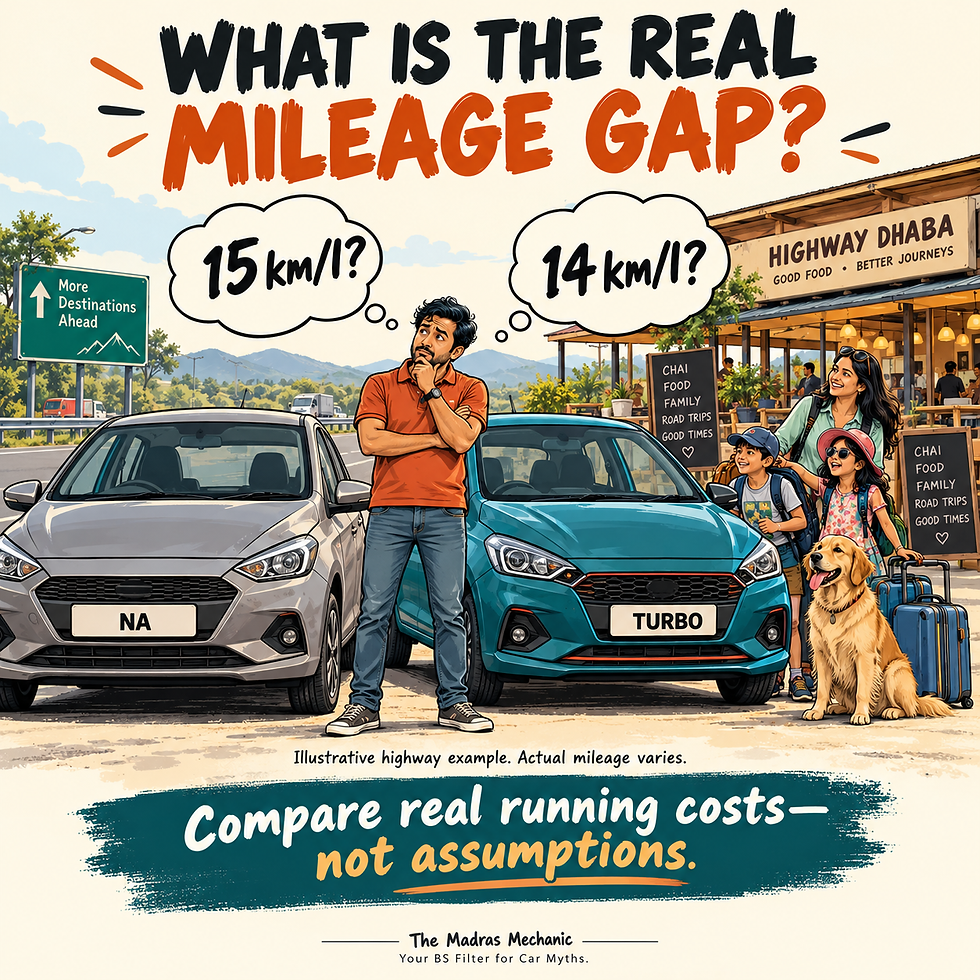
But in the cars and customer experiences I regularly encounter, I often see a much narrower gap. Think of an NA returning around 15 km/l on the highway and the turbo returning around 14.
These are workshop observations and customer experiences, not a controlled comparison or a promise for every car. Different gearboxes, routes, traffic, speeds, and driving styles can change the result considerably.
Still, the pattern matters. It challenges the assumption that choosing a turbo necessarily means accepting terrible mileage.
If the actual difference for your usage is relatively small, would you still want to give up the additional performance?
For me, that is the question worth asking.
What does that difference cost?
Using that 15-versus-14 example, let’s assume you cover 12,000 km a year at those averages and petrol costs ₹100 per litre.
Fuel economy | Approximate annual fuel cost |
15 km/l | ₹80,000 |
14 km/l | ₹85,714 |
Difference | ₹5,714 |
That works out to approximately ₹476 a month.
This is an illustration, not a prediction of your annual mileage. A highway observation cannot automatically represent a year of mixed city and highway driving.
But it shows why you should calculate the expense instead of deciding that “turbo means expensive to run.”
The purchase premium still matters, of course. If it stretches your finances, that deserves serious consideration. But if you can comfortably afford the turbo version, a modest fuel-cost difference may be worth the everyday benefit.
An extra 20-30 horsepower is a meaningful difference
In a small family car, another 20-30 horsepower is a substantial increase.
You don’t have to use all of it constantly to appreciate it. The benefit is having more performance available when the car is loaded or you need to accelerate.
The torque delivery and gearbox matter just as much as the headline power figure. What you feel is how readily the complete car responds.
This is why my preference for turbo engines goes beyond excitement.
I like a car that makes the journey feel easy.
Buy for the family trip as well as the office commute
Your daily commute might involve one person, a laptop bag, and slow traffic.
But what else are you buying the car for?
Trips to your hometown? Holidays with the family? Four or five occupants, luggage, and hill roads?
Those journeys deserve a place in the buying decision too.
An engine that feels adequate during an empty-car test drive can feel very different with everyone aboard. It may require more downshifts and more revs to deliver the acceleration you want.
There is nothing wrong with using an NA engine’s rev range. That is how many of them deliver their performance. But if you find that tiring or frustrating, you should discover it before buying the car.
For someone regularly travelling with family and luggage, I would generally recommend the turbo version if the budget allows and the engine-and-gearbox combination performs well on the test drive.
Where an NA still makes sense
If you mostly travel alone or with one other person, drive calmly, and are satisfied with the car’s acceleration, an NA can be an excellent choice.
That includes occasional highway journeys. Highway use alone does not make a turbo necessary.
If your car mainly handles relaxed office commutes, sees limited annual use, and comfortably meets your needs, there may be little reason to pay extra for performance you don’t particularly value.
But low annual mileage does not automatically settle the question either. Someone who drives infrequently but mainly takes fully loaded family holidays may still appreciate the turbo.
Look at how you use the car, not just how often.
Your money. Your engine. Insist on the right test drive.

This is the part that genuinely bothers me.
A showroom has a fully loaded, top-of-the-line car for test drives. Nothing wrong with that. Naturally, they want to showcase the best of what they sell.
But if they sell different engines and gearboxes, buyers should have an opportunity to experience the combination they are considering.
You drive the powerful turbo version. It feels responsive. The car accelerates nicely. You’re impressed.
Then the conversation shifts to the NA.
“Sir, better mileage.”“Sir, lower price.”“Sir, immediate delivery. Your colour also available.”
Fine. Then let me drive that one.
“Sir, that test-drive car isn’t available.”“It has gone outside.”
I have personally encountered these responses repeatedly, and customers have described similar experiences to me.
Apparently, the car is available in every colour, just not available to drive.
The problem isn’t showcasing the expensive version. The problem is using that experience to sell you a different engine without giving you a fair opportunity to understand the difference.
A sunroof you can see. Seat upholstery you can touch. Engine response with your family aboard? You need to drive the car to understand that.
Sometimes the sales argument also includes, “This one has 200 cc more.”
But a 1.2-litre NA and a 1.0-litre turbo are different engines with different characteristics. Capacity alone does not establish performance or fuel economy.
The same body, dashboard, and badge do not guarantee the same driving experience.
A sales recommendation can become your expensive regret

At the workshop, I meet owners who are genuinely frustrated.
“Bro, I thought it would drive like the test-drive car.”“With my family inside, it feels sluggish.”“Even pulling away from a signal, I have to press the accelerator much more than I expected.”
That doesn’t mean every NA car is inadequate. It means these buyers ended up with a driving experience that didn’t meet their expectations and say they weren’t given the chance to discover that before paying.
What upsets me is the money involved.
This isn’t a ₹10,000 purchase you can shrug off. Someone may have saved for years, committed ₹10-15 lakh or more, and taken on monthly instalments to buy this car.
That money represents their work, their sacrifices, and their family’s plans.
Salespeople have considerable influence over that decision. That influence comes with responsibility.
There is nothing wrong with selling an available car, recommending a cheaper variant, or earning an incentive. But the recommendation should come with an honest explanation of what changes and an opportunity to experience it.
I cannot know the intention behind every sale. But if a buyer is knowingly led to expect the turbo’s performance from the NA, I consider that misleading selling. A customer left feeling cheated isn’t going to find much comfort in the showroom having achieved its monthly target.
My rule is simple: no suitable test drive, no purchase
Ask clearly:
“I want to drive the engine and gearbox I am planning to buy.”
The test-drive car doesn’t need to be your preferred colour or have identical upholstery. But it should represent the powertrain you are paying for.
Take your family along where possible. Use the AC. Try normal traffic, an incline, and ordinary acceleration. Find out whether the car feels comfortable for your needs.
If that version is temporarily unavailable, arrange another date. If the dealership cannot provide it, try another dealership.
If you cannot get a representative test drive, don’t commit to buying the car.

You are not being difficult. You are making an informed purchase.
If you drive the NA, understand its performance, and decide it suits you, excellent.
Buy it confidently.
But that should be your decision, made from your experience, not an expectation borrowed from a more powerful test-drive car.
Your savings are not a showroom’s sales target. Drive the engine you’re buying before you pay for it.
Should you still be worried about owning a turbo?
A turbo badge alone is not a reason to reject a car.
Equally, it isn’t a reason to ignore the requirements of that particular engine.
Check the specified fuel grade, service schedule, oil requirements, ownership history where relevant, and the support available for the model you are buying.
Avoid treating every turbo engine as the same product. Judge the actual car.
And remember that the transmission matters too. A turbo paired with a gearbox you dislike in traffic may be a worse fit for your daily life than an NA with a transmission you enjoy.
Can tuning improve mileage?
At ICD Tuning, we have tuned cars whose owners subsequently reported better fuel economy alongside improved drivability.
Those reports are worth discussing, but they aren’t a guarantee for every owner or every car. Establishing the improvement properly requires comparable before-and-after measurements, ideally across several tankfuls under similar conditions.
Using more of the available performance can also increase consumption.
My advice is to buy a car you are happy with in stock form. Treat tuning as a separate, informed decision, rather than the plan for correcting a purchase that doesn’t suit you.
My recommendation
If you can comfortably afford the turbo version, regularly travel with family and luggage, and appreciate stronger acceleration, it would usually be my recommendation.
You gain performance that can be useful in ordinary driving, and the mileage difference may be much smaller than you were led to expect.
If you are a calm driver whose needs are comfortably met by the NA, buy it with confidence. There is no prize for paying for performance you don’t want.
But make that choice after driving both.
Don’t give up an engine you would enjoy for years because of a mileage saving you have never actually verified.
Gettuned to what’s real! Stay informed.
Yours truly,
The Madras Mechanic
Your BS Filter for Car Myths.


Comments